
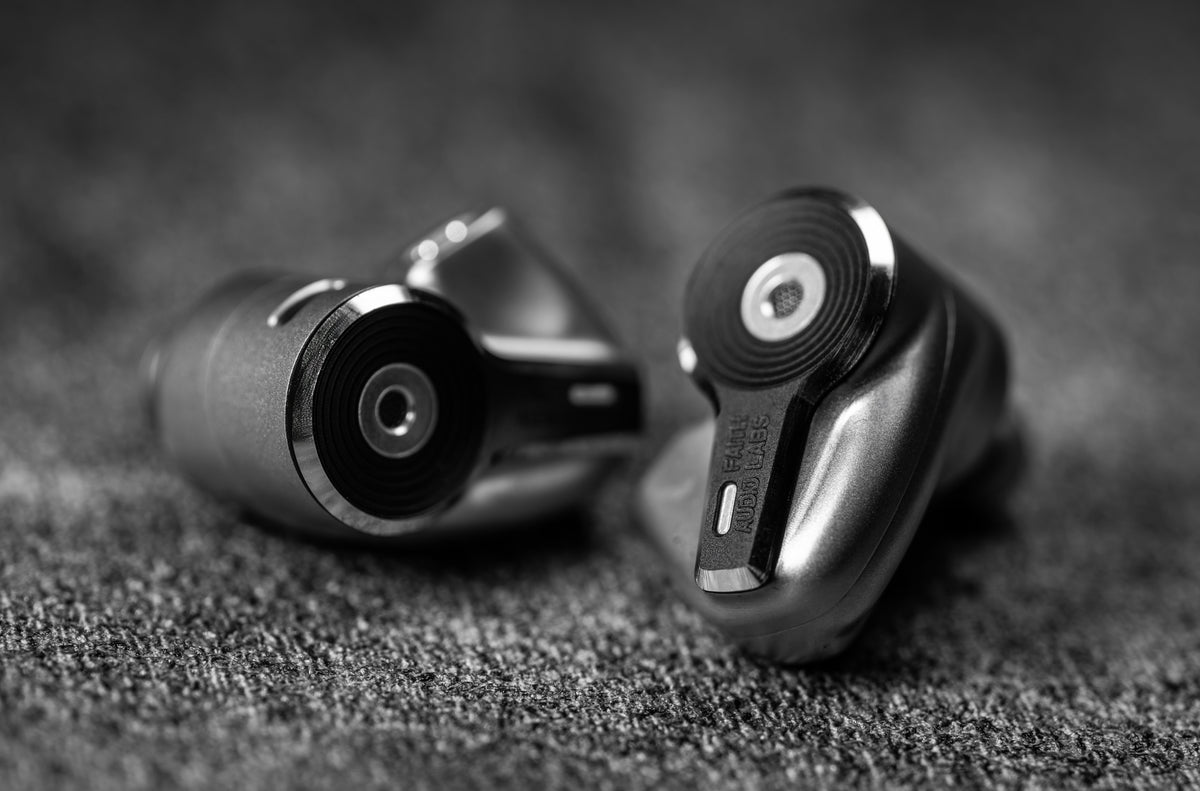
Product: Faith Audio E800
Driver Config: Single Full-Range Dynamic Driver + Auxiliary Passive Diaphragm, Three-Chamber Acoustic Architecture
Sound Signature: Mild U-Shape
Tonality: Natural, Slightly Warm, Dynamic, Clear
Highlights: Faith Audio's signature natural tonality and spacious soundstage, now with substantially more powerful bass. A balanced, mildly U-shaped tuning with warm lower mids, solid impact, and good versatility across genres. The longer nozzle also brings a major improvement in comfort over the E1000 and U1000.
Suited Genres: Pop, Rock, Metal, Electronic, R&B, Jazz, Acoustic, and Orchestral.
Impressions
I've always liked Faith Audio's approach to single dynamic-driver IEMs. Both the E1000 and U1000 have a natural, low-coloration sound with a spacious presentation that makes them stand out. The E800 keeps those qualities but takes the tuning in a more energetic direction. At $999, I'd go as far as calling it one of the best-value single dynamic-driver IEMs I've heard around the $1,000 mark. It doesn't quite match its more expensive siblings, especially the U1000, in resolution or instrument texture, but for certain genres, I actually prefer the E800.
Bass & Tonal Balance
The bass is easily the biggest improvement. Compared with the E1000 and U1000, the E800 delivers considerably more weight, punch, and low-frequency presence. Kick drums hit with real authority, bass guitars have a solid foundation, and electronic bass lines carry plenty of energy. More importantly, the bass feels controlled and extends naturally without becoming muddy or overly thick. It is a substantial change from Faith Audio's previous tuning approach, and one that makes the E800 much more enjoyable with pop, rock, and electronic music. For these genres, I would even take it over the two higher-end models.
There is also a touch of warmth in the lower mids that gives vocals and instruments a fuller, more natural body. The coloration is subtle and doesn't interfere with Faith Audio's familiar tonal balance. Despite the extra bass energy, the midrange remains clear and properly proportioned, avoiding the recessed character sometimes associated with U-shaped tunings.
Midrange, Treble & Soundstage
The midrange stays true to Faith Audio's house sound: natural, clean, and relatively free of coloration. Vocals have good body, and instruments retain convincing timbre. Compared with the U1000, the E800 gives up a little in fine detail and instrumental texture, but the difference doesn't take away from its overall musicality. The stronger bass also gives the midrange a more grounded character, making the presentation feel fuller without becoming congested.
The treble is where the E800 shows some limitations. It isn't noticeably brighter than the E1000 or U1000, and I haven't encountered any obvious sibilance. The difference is mainly in texture. Certain consonants have a slightly harder edge, and fine treble details aren't quite as smooth or delicate as those of its more expensive siblings. This is less noticeable with instruments, where the added firmness can work quite well, but vocals reveal the difference more clearly. It's a relatively small compromise, though one worth mentioning at this price.
The E800 also retains Faith Audio's naturally wide and open soundstage. Instruments have plenty of room, separation is clean, and the presentation never feels artificially stretched. Combined with the stronger bass, the E800 creates a fuller and more engaging sound without losing the spaciousness that made the E1000 and U1000 appealing in the first place.
Design & Comfort
One of my biggest complaints about the E1000 and U1000 was their short nozzles. I often struggled to get a comfortable fit, regardless of how much I enjoyed their sound. Thankfully, Faith Audio has addressed this with the E800. The longer nozzle makes a huge difference for my ears.
On the first day, I wore the E800 for six hours straight without any discomfort or urge to take it off. That alone is a major improvement. The E800 is not only easier to enjoy musically, but also much more comfortable to live with. For me, the fit improvement is almost as important as the new bass tuning.
Final Thoughts
The E800 isn't simply a cheaper E1000 or U1000. It offers a different balance, with stronger bass, a little more warmth, and much greater versatility for modern music. It still carries Faith Audio's natural tonality and spacious presentation, but now has the punch and energy that I sometimes missed from the earlier models.
The U1000 remains the more resolving and refined IEM, especially when it comes to instrumental textures and treble finesse. But the E800 has its own advantages, and for pop, rock, and electronic music, I often find it more enjoyable. Add the dramatically improved comfort, and it's hard not to appreciate what Faith Audio has accomplished here.
At $999, the E800 is one of my favorite single dynamic-driver IEMs in its price range. It strikes an excellent balance between sound quality, versatility, comfort, and value.
FR Measurement

Engineering Insight: The 7 kHz Trade-Off
The E800's frequency response shows a noticeable peak around 7 kHz, a region that can affect how we hear vocal consonants, cymbal attacks, and other fine treble details. Extra energy here can make sounds more defined, but it can also give their edges a slightly harder character.
That's close to what I hear with the E800. It doesn't sound overly bright or sibilant, but certain vocal articulations have a little more bite than they do on the U1000. The difference is more about texture than brightness. While a 7 kHz measurement alone cannot establish the cause, it offers a possible explanation for why the E800 sounds clear and articulate, yet isn't quite as delicate or refined as its more expensive siblings.
Share:
YBA VIBE P1 First Impressions. Bonus: The Battle of the Big Dongles — Five Flagships, One Showdown!