
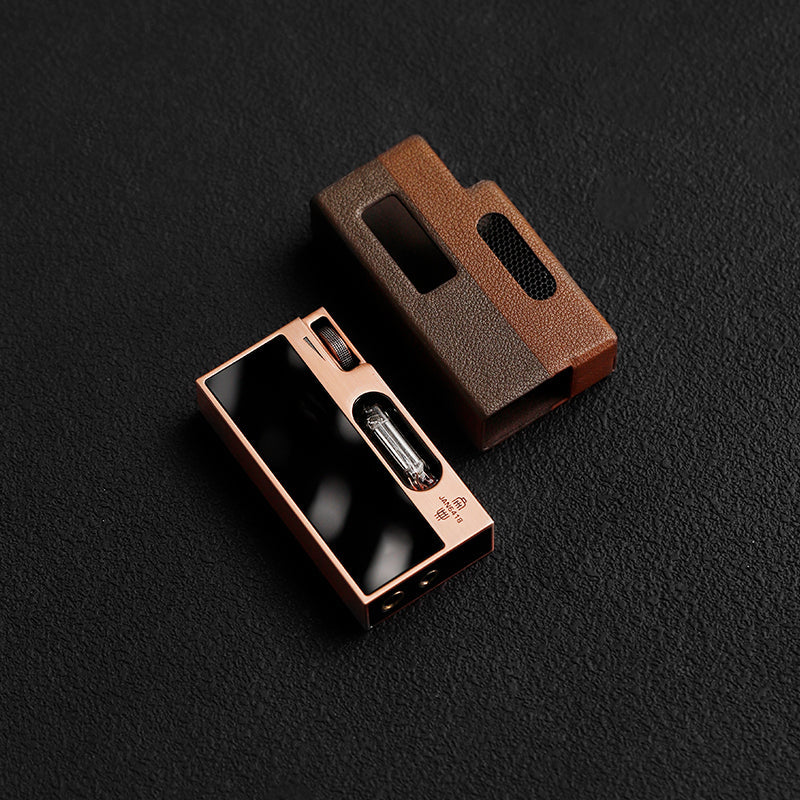
Product: Shanling UA7 Cu Copper Edition
DAC Configuration: ESS ES9069 DAC + Dual JAN6418 Vacuum Tubes
Sound Signature: Warm, Rich, Full-Bodied
Highlights: Beautifully crafted copper chassis with a gorgeous vintage finish, intuitive multifunction control wheel, and a remarkably elegant OLED interface. An exceptionally rich and enveloping sound with full, rounded bass, sweet and lush mids, and smooth yet airy treble. Switchable tube and solid-state modes offer two subtly different interpretations of Shanling's signature musicality, complemented by eight digital filter options for further fine-tuning.
Suited Genres: Jazz, Blues, Soul, R&B, Vocal, Acoustic, Pop, and Classic Rock.
Impressions:
If there is one word I would use to describe the UA7 Cu, it would be richness. Not just a touch of warmth or a slightly fuller presentation, but an almost indulgent level of richness that runs through the entire frequency range. This is Shanling's house sound taken to a rather delightful extreme, with a thick, lush, and beautifully relaxed character that makes music feel wonderfully inviting.
The bass is big, generous, and exceptionally satisfying. Rather than delivering a sharp, explosive punch that immediately retreats, the UA7 Cu favors a rounder, more substantial impact. There is a certain looseness to the presentation, but in the most enjoyable sense of the word. Each bass note feels almost like a warm, heavy embrace, wrapping around the music with a comforting sense of weight and presence. It is not the kind of bass that prioritizes razor-sharp attack or absolute tightness, but one that makes the music feel wonderfully full and immersive.
The midrange is where Shanling's DNA becomes unmistakable. Rich, velvety, and almost syrupy sweet, vocals carry a beautiful sense of body and warmth. There is a noticeable coloration here, and I would hardly call it neutral, but that is precisely what makes it so charming. Instruments sound rounded and organic, while vocals are presented with a smooth, intimate sweetness that is incredibly easy to fall in love with. If you have enjoyed the characteristic midrange of Shanling's higher-end players, the UA7 Cu will feel immediately familiar.
The treble follows a philosophy similar to its bigger sibling, the M8T. Smoothness remains a priority, yet there is still enough extension and air to prevent the presentation from becoming overly dark or closed-in. Fine details emerge with a gentle, effortless quality rather than being pushed forward. It is a particularly pleasing balance considering just how rich and warm the rest of the sound is.
Tube vs. Solid-State
One of the most enjoyable features of the UA7 Cu is the ability to switch between tube and solid-state operation. Importantly, the fundamental character remains consistent in both modes. Neither setting transforms the UA7 Cu into a completely different-sounding device, but the differences are noticeable enough to make switching between them genuinely worthwhile.
With the tubes engaged, the bass becomes even more enveloping, with a rounder impact and a slightly softer attack. Turning the tubes off brings a firmer punch, a drier texture, and a greater sense of control. The difference is subtle, but it changes how the low frequencies interact with the rest of the music.
To my ears, the midrange reveals an even more noticeable difference. Tube mode brings additional roundness and smoothness, making vocals sound more fluid and velvety. Solid-state mode, on the other hand, introduces a slightly grainier, more textured character, with clearer edges and greater definition. Neither is necessarily better; they simply offer different flavors of the same beautifully rich foundation.
The treble also changes in an interesting way. With the tubes on, the upper frequencies gain a little more air, and the highest overtones seem to disperse more freely into the surrounding space. Switching to solid-state tightens those outlines, giving the treble a more focused shape and a quicker, more immediate response.
Personally, I find both modes equally enjoyable depending on the music and the IEM pairing. Tube mode is particularly charming when I want to sink into the music, while solid-state offers a little more energy, definition, and rhythmic precision.
Design & Usability
As much as I enjoy the sound, I have to admit that the physical design may be just as impressive.
The UA7 Cu is, without question, the most beautiful and best-built dongle DAC I have personally encountered. And for once, I do not feel the need to add "one of." Of course, I should confess that I have a serious weakness for vintage copper finishes. If your preference leans more toward polished, mirror-like brass, the Luxury & Precision W4 ACG would certainly be a strong contender.
The copper chassis feels substantial and beautifully finished, with a sense of solidity that few dongles manage to achieve. The additional weight is noticeable, but it also contributes to its luxurious feel. This is not a device that prioritizes being as small and lightweight as possible.
Operation is refreshingly straightforward. Nearly everything is handled through a single multifunction control wheel. It manages playback and pause, menu access and confirmation, and volume or menu navigation through rotation. The entire experience feels intuitive, without the clutter of multiple buttons.
And then there is the screen.
I genuinely cannot get enough of the OLED interface. The animations are exceptionally smooth, with beautifully paced transitions that make even the simplest adjustments feel surprisingly premium. In fact, I found myself going through every single DAC filter option partly because I wanted to watch those animations again. It is a small detail, but one that gives the UA7 Cu an unusually refined user experience.
Speaking of DAC filters, the UA7 Cu offers eight different options, covering familiar linear-phase and minimum-phase designs with different roll-off characteristics, alongside more specialized options such as Low-Ripple and Low-Dispersion.
Digital filters are not going to fundamentally change the character of the sound, and their audible influence is generally subtle. Still, with careful listening, I find that different filters can slightly alter the perceived outlines of notes, fine textures, and the character of transients and dynamics.
After experimenting with all eight options, F5 (Minimum Phase Fast Roll-off) became my personal favorite. To my ears, it offers a slightly more open presentation with a satisfying sense of dynamic contrast, complementing the UA7 Cu's naturally rich personality particularly well.
Overall, the UA7 Cu is a wonderful example of how a dongle DAC can offer more than convenience alone. Its unapologetically lush sound, thoughtfully implemented dual-mode operation, gorgeous copper construction, and delightful interface give it a personality that feels unusually complete.
It is certainly not the most neutral or sharply defined presentation, nor is it the lightest dongle to carry around. But if you enjoy a thick, warm, wonderfully musical sound and appreciate beautifully crafted audio equipment, the UA7 Cu is an exceptionally charming little device.
Share:
OASEAR Alioth First Impressions